Mission
To explore and develop water-treatment systems that combine scientific clarity, resource efficiency and practical engineering.
The NURIT story
We are building a Clay model, the we will print a 3D model and you will find us factories in India 🇮🇳 and call centers worldwide. The patent belongs to Shimon the CEO.
↓Who we are
NURIT works at the intersection of water treatment, applied physics, mechanical design and environmental engineering. Its purpose is to investigate systems that can treat water while reducing avoidable chemical dependency, improving how energy is applied and recovering useful value from process outputs.
Rather than treating desalination as a single isolated operation, NURIT considers the complete system: incoming seawater, separation behaviour, thermal requirements, water recovery, mineral streams, energy use, controls and the path toward practical implementation.
The work is research-led but implementation-focused. Every concept must ultimately move through calculation, component design, prototyping, measurement and real-world validation.
“A water system should be designed as a connected resource ecosystem—not simply as a machine that separates water from waste.”
Our purpose
Clear intent keeps ambitious technology work grounded in useful questions, measurable learning and responsible decisions.
To explore and develop water-treatment systems that combine scientific clarity, resource efficiency and practical engineering.
A future in which clean water, useful minerals and available energy are considered together as parts of one integrated process.
To move carefully from concept to evidence, testing each technical assumption before progressing toward larger-scale implementation.
The challenge
Conventional desalination has made large-scale freshwater production possible, but many systems can involve significant energy demand, extensive pretreatment, chemical consumables and concentrated waste streams.
NURIT begins with a different question:What if separation could be designed around the material’s own measurable physical properties?
This question leads to a proposed system that investigates direct electric and magnetic separation, lower-temperature evaporation, focused solar thermal input and the recovery of useful outputs.
The objective is not to promise immediate replacement of established methods. It is to create and validate an alternative engineering pathway through disciplined research and staged development.
Our approach
NURIT’s proposed process is organised into two connected stages, each requiring evidence before the next.
Stage I / Direct physical separation
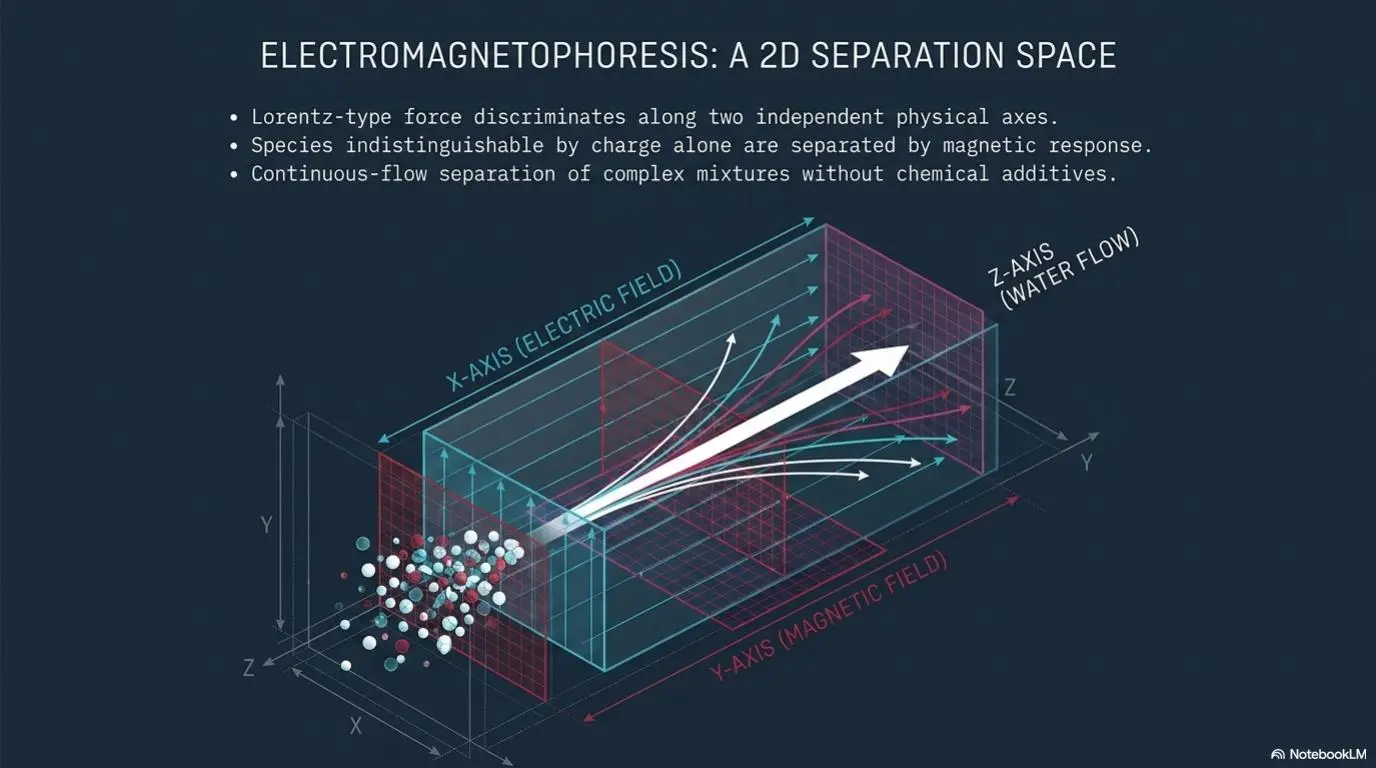
Electrophoretic behaviour may support separation through differences in surface charge, while magnetophoretic behaviour may support separation through differences in magnetic susceptibility. The concept proposes arranging these forces across independent physical axes to create a controlled separation space for continuous-flow treatment.
Stage II / Sub-vacuum thermal processing
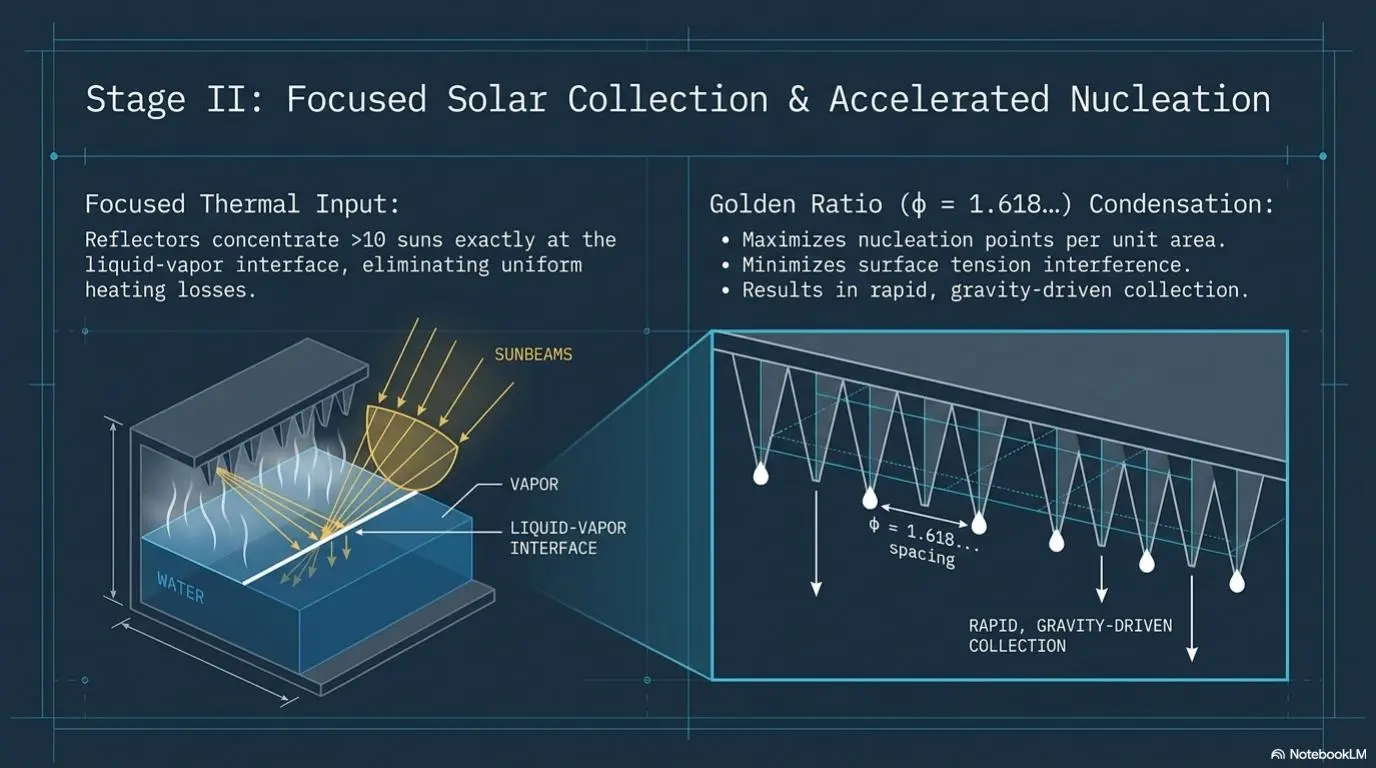
At sub-atmospheric pressure, water boils at a lower temperature. This may allow available thermal energy or focused solar input to support phase change with reduced high-temperature heating requirements. The proposed system also investigates condensation geometry and water recovery.
The connected system
NURIT’s long-term system vision extends beyond the production of freshwater. It considers whether process streams can be organised so that each stage supports another.
Direct separation could reduce scaling and fouling before thermal processing. Thermal energy could support evaporation. Condensation could recover water. Mineral-rich streams could be evaluated for useful recovery instead of being viewed only as waste.
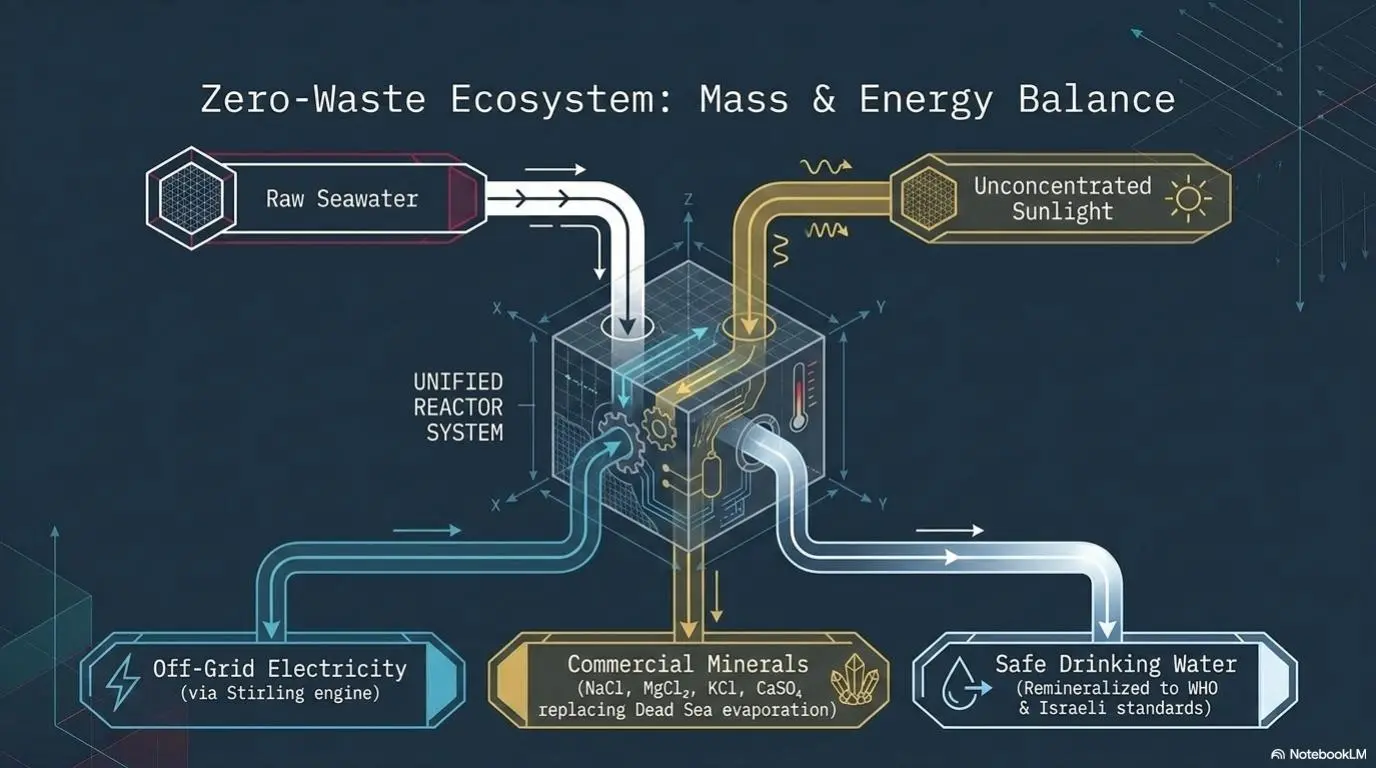
These are development objectives. Final performance, water quality, energy use and recovery rates must be established through prototype and pilot testing.
What guides the work
System decisions should begin with measurable material behaviour, energy balances and physical constraints.
Each development stage should produce the data required to justify the next investment in size and complexity.
Separation, thermal processing, condensation, minerals, controls and energy should be designed as connected parts of one system.
Process outputs should be evaluated for potential reuse or recovery before they are classified as waste.
A strong concept must eventually become a system that can be built, controlled, maintained and operated safely.
Development pathway
The timeline is a proposed sequence. Evidence at each stage determines whether and how the work proceeds.
Validate scientific assumptions, calculate expected forces and energy requirements, identify technical risks and define measurable success criteria.
Build controlled laboratory systems to evaluate separation behaviour, pressure conditions, thermal input, condensation and material compatibility.
Connect the strongest individual components into a complete working process and measure interactions between stages.
Test realistic water conditions, longer operating periods, process controls and practical maintenance requirements.
Evaluate manufacturing, automation, regulatory requirements, cost, safety, capacity and deployment models.
Capabilities
Connecting separation, thermal processing, condensation, recovery and controls into one coherent system.
Exploring electric, magnetic and material responses as possible tools for direct separation.
Investigating reduced-pressure evaporation, solar thermal input and efficient condensation.
Turning early concepts into components, assemblies and testable physical systems.
Using calculations and process data to define operating conditions and improve repeatability.
Preparing technical concepts for prototype, pilot and future commercial evaluation.
Connected by collaboration
NURIT brings together the research, engineering and commercial perspectives required to move complex water technologies from concept toward practical validation.
NURIT focuses on the scientific and engineering work needed to investigate new desalination, separation and resource-recovery systems.
NURIT is presented as part of the wider innovation ecosystem of ES VENTURE and Aquatech.
The NURIT Water Desalination System is presented by ARC Technologies.
Capabilities brought into the conversation
NURIT is part of ES VENTURE and Aquatech. The NURIT Water Desalination System is presented by ARC Technologies.
Work with NURIT
NURIT welcomes conversations with organisations and professionals working across water technology, desalination, environmental engineering, applied research, manufacturing and sustainable infrastructure.
Begin a conversation
Whether you are exploring a technical partnership, research opportunity or engineering challenge, NURIT is ready to begin the conversation.